
Home ❯ Expert insights ❯ LLM SEO strategy: Get referenced, not just ranked
LLM SEO strategy: Get referenced, not just ranked
SEO is shifting from rankings to references. Learn how to structure content for AI Overviews and LLMs so your brand gets cited, mentioned, and trusted.


AI-first interfaces are quickly becoming the first place customers go to understand a problem, compare options, and make a decision. Google’s AI Overviews, chat-style search, and tools like ChatGPT, Copilot and Perplexity don’t simply return a list of links anymore, they summarise the web into an answer.
That shift creates an uncomfortable reality for brands: you can still “rank” and never get mentioned. And if you’re not mentioned in the answer layer (where people often now form their first impression) you’re effectively invisible at the moment it matters most.
This is the new game: being found is moving from ranking to being referenced. In this post, we’ll lay out a practical playbook for how to adapt your SEO strategy for LLMs and AI search, so your brand shows up clearly, credibly, and consistently.
Why discovery changed (and why it matters)
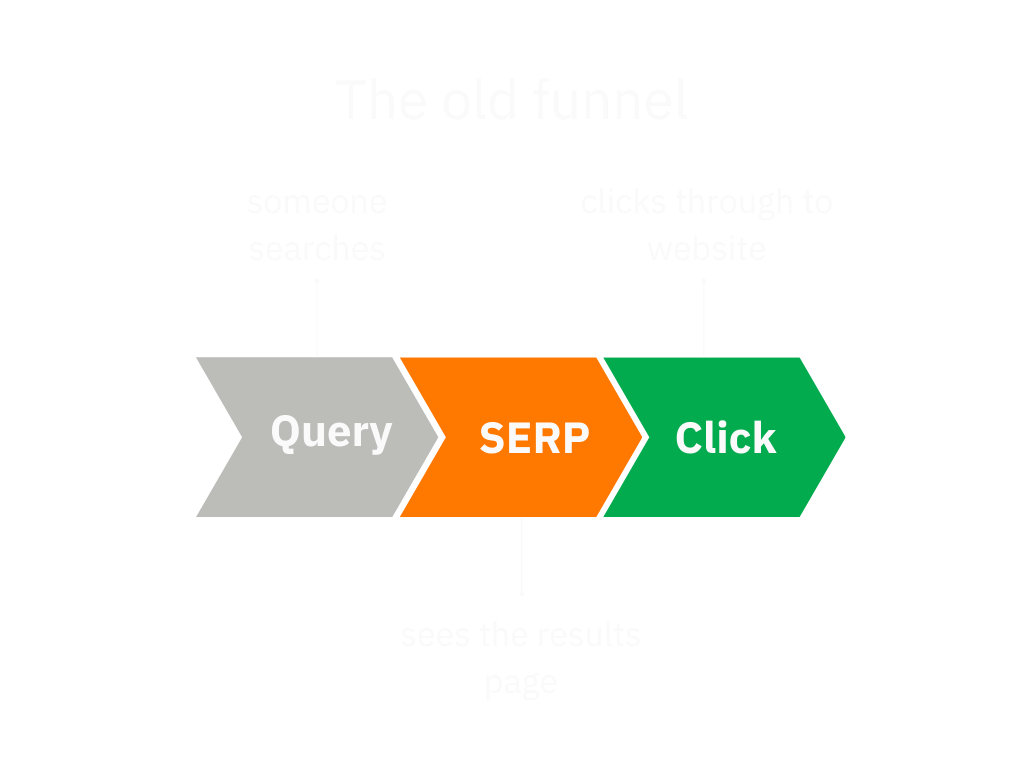
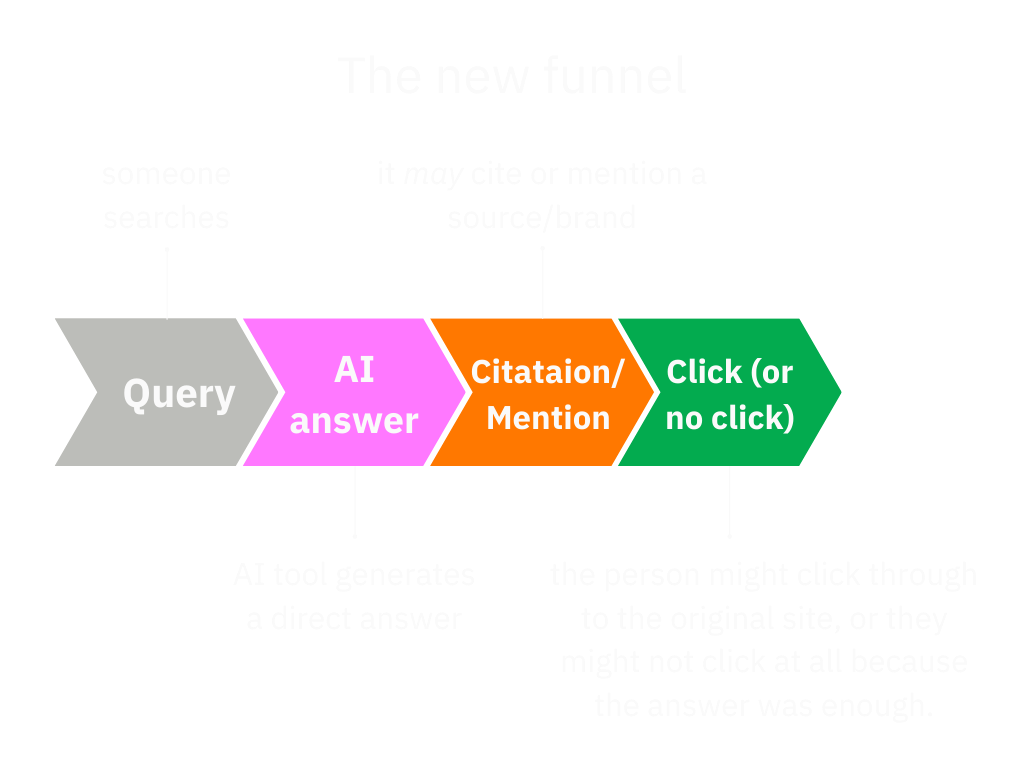
For years, the search journey looked like a straight line: someone typed a query, scanned the results, clicked a link, and discovered your brand inside your website. AI search compresses that journey. Now, a single question can produce a synthesised response that feels complete enough to end the search entirely – especially for early-stage research.
That’s why “visibility” has expanded. It’s no longer only about blue-link rankings; it’s also about whether you appear as a cited source, a named recommendation, or an example embedded inside an AI-generated explanation. As McKinsey describes, AI search is the new “front door” to the internet; consumer behaviour is already shifting, and the implications are commercial, not cosmetic.
The risk is straightforward: if your content isn’t written and structured in a way machines can reliably extract, your story can be misrepresented, diluted, or skipped altogether. In an answer-first world, clarity isn’t a nice-to-have. It’s your distribution.
What LLMs “prefer”: a useful mental model
The simplest way to understand LLM visibility is to stop thinking like a ranking algorithm and start thinking like a summariser. A summariser is constantly asking: “Can I confidently lift this into an answer?”
In practice, that means two things outperform almost everything else: clarity and structure. LLMs tend to favour content that explains concepts clearly, deeply, and in a well-structured way.
Instead of thinking of LLM SEO as a replacement of classic SEO, we can look at it as an adaptation of classic SEO. So, instead of writing content that slowly reveals the point, write like you expect to be quoted. Put the direct answer early. Use headings that match real questions. Define your terms. Add constraints and “when not to do this” guidance. Include examples people can apply. The goal is to make it easy for the model to be accurate.
A simple pattern that works well for both humans and AI is a short TL;DR section near the top, followed by a clear definition of the problem, then a step-by-step approach, and finally a section that translates theory into practical decisions. It reads cleanly, it scans well, and it gives AI systems multiple “extractable” units they can safely include.
Traditional SEO
LLM SEO (AI search)
Goal
Rank well and earn clicks
Get referenced in AI answers (mentions/citations) and earn trust-based visits
User journey
Query → SERP → Click → Website
Query → AI answer → (maybe) citation/mention → (maybe) click
Visibility surface
SERP listings (blue links + rich results)
AI summaries + conversational answers
Winning content
Keyword + intent-aligned pages
Answer-first pages (definitions, steps, constraints, examples)
Authority & trust
Backlinks, topical authority
Same, plus clearer authorship, evidence, and experience signals
Strategy
Target keywords and intent buckets
Cover “query fan-out” (supporting sub-questions + comparisons)
Measurement
Rankings, CTR, organic traffic, conversions
Mentions/citations in answers, AI referrals, assisted conversions
How Restive sees it
- Clarity: intent mapping
- Credibility: auhtority
- Crawlability: technical SEO
- Clarity: extractable answers
- Credibility: E-E-A-T signals
- Crawlability: accesible structure
The new optimisation stack: SEO hygiene + LLM visibility
At Restive, we think about this shift through a simple chain: Clarity → Credibility → Crawlability.
Why that order? Because most teams jump straight to tactics – schema, bots, and “LLM optimisation hacks” – while their underlying message is inconsistent, their proof points are thin, and their platform makes content hard to crawl or trust. If your web platform, product information, and content systems are fragmented, AI discovery gets harder. You end up with duplicate pages, conflicting claims, outdated docs, and a brand story that changes depending on which page the model reads first.
Clarity: say the thing (and say it the same way everywhere)
Clarity means your positioning is explicit and repeatable. It’s your category, your audience, your differentiators, and the language you use to describe them. AI models don’t “infer” intent the way a human does. If your language varies wildly across pages, the summary will too. Clarity is also about writing in a way that supports extraction: short sections, purposeful headings, and direct answers.
Credibility: prove it with signals AI can recognise
Credibility is where thought leadership actually lives. Not in hot takes, but in defensible specificity: clear frameworks, evidence, original insights, and transparent reasoning. When you include examples, constraints, and references, you give both readers and models a stronger basis to trust your perspective. You don’t need to turn your blog into an academic paper, but you do need to demonstrate you’ve done the work.
Crawlability: make it accessible, fast, and unambiguous
Finally, crawlability is still foundational SEO done properly: clean site architecture, reliable indexation, performant pages, and consistent internal linking. It also means using structured data where it’s accurate and helpful, not as decoration. Strong technical SEO foundations are still important for inclusion in AI search answers, because these systems still need to access and interpret the underlying web, so don’t throw out the rule book just yet.
This is the part many organisations underestimate: AI visibility often depends on the same technical truths as traditional visibility. The difference is what happens after the model reads you.
Where E-E-A-T fits (and why it matters for LLM SEO)
If you’ve spent time in SEO, you’ve probably heard of E-E-A-T: Experience, Expertise, Authoritativeness, and Trustworthiness. Google’s human quality raters use E-E-A-T as a framework to assess content quality in the Search Quality Rater Guidelines (essentially, it’s a way of describing what a “good result” looks like). Importantly, Semrush notes that trustworthiness is the central concept within E-E-A-T, and that E-E-A-T itself isn’t a confirmed direct ranking factor — but improving it aligns your content with what Google considers high-quality and helpful.
So why mention E-E-A-T in a post about LLM SEO?
Because the behaviour E-E-A-T encourages is exactly what LLM-driven discovery rewards. AI systems are trying to summarise the web without misleading people. They gravitate toward sources that are consistent, specific, and credible, and that’s what E-E-A-T is really about.
In practice, you “show” E-E-A-T by building pages that make it easy for a machine (and a human) to answer three questions quickly:
In practice, you “show” E-E-A-T by building pages that make it easy for a machine (and a human) to answer three questions quickly:
1) Who is behind this content?
2) Why should we trust it?
3) What proof supports the claim?
That might look like first-hand experience in your examples, clear authorship, crisp explanations, references that back up your statements, and content that’s maintained (not left to rot). If you want to be quoted, you need to be trustworthy enough to quote, and E-E-A-T is one of the clearest mental models for designing that kind of content.
Query fan-out: why one keyword is no longer enough
One of the biggest conceptual shifts in AI search is that the system doesn’t always run a single query. It may break the user’s question into many related sub-questions, gather material across those angles, and then synthesise the final response. Google refers to this as “query fan-out.”
For brands, the implication is important: you’re not only competing on “the main keyword.” You’re competing across the supporting questions that shape the answer – definitions, comparisons, trade-offs, implementation steps, and common objections. This is why pillar-and-cluster content becomes even more valuable in the AI era. It doesn’t just help you rank; it gives the model a cohesive, multi-angle body of material that reinforces your expertise and makes your brand easier to cite.
A practical playbook: what to do now
If you’re wondering where to start, start with the pages that already matter: your core service pages, your key category explainers, and the content that supports sales conversations. These are often the pages that get summarised, referenced, and compared.
Begin by rewriting intros so the answer appears early instead of being buried under context. Add a short TL;DR section that names the point of view and who it’s for. Make sure each page includes one clear definition of what the topic is, and one clear explanation of why it matters. Then add the “missing middle”: the practical guidance that helps a reader decide what to do next. This is where many sites fall down, and it’s also where AI answers tend to become vague.
Once the foundations are in place, build supporting pages that map to high-intent questions your buyers ask during research. Not dozens, just a handful that cover the decision journey. Think “how it works,” “how to choose,” “what it costs,” “what to avoid,” and “what good looks like.” The goal is to create a set of pages that a model can stitch into a complete, credible explanation.
If you want to experiment, you can keep an eye on emerging conventions like /llms.txt, which aims to provide LLM-friendly guidance for site usage. It’s early and not yet universal, so it’s best treated as a monitored experiment rather than a core strategy.
Should you block AI crawlers?
This question comes up in almost every conversation right now, and the honest answer is that it depends on your business model and your appetite for trade-offs.
Yes, some AI systems rely on crawlers and user agents, and site owners can manage access using robots.txt and related controls. OpenAI documents how its bots work and how to control access.
But there’s also a real commercial tension here. If AI serves the information directly to the user, click-through rates to the original source can drop. That can reduce web traffic, shrink exposure to the broader depth of your site, and (depending on your revenue model) create downstream pressure on pipeline, and overall company success metrics.
So the decision isn’t “block or allow.” It’s “what are we protecting, and what visibility are we trading away?” For many brands, the most practical stance is selective: protect truly proprietary or paid content, but keep the high-value explainers, frameworks, and source-of-truth pages accessible so you can still earn mentions in the answer layer.
It’s also worth noting that the ecosystem is contested and evolving. There have been public disputes about AI crawling practices and enforcement, which is another reason organisations are moving toward nuanced, policy-led decisions rather than blanket rules.
Measurement: how to know this is working
In the AI era, measurement needs a broader definition than “did traffic go up?” Traffic still matters, but the earlier signal is visibility inside the answer layer.
A simple approach is to build a small set of category questions (your “AI visibility queries”) and check them monthly across the tools your buyers actually use. Record whether you appear, how you appear (citation, mention, recommendation), and what sources the model chose instead when you didn’t show up.
Then match that to your analytics: referral traffic from AI tools where available, Search Console patterns on informational queries, and assisted conversions influenced by thought leadership content. As a practical lens, it’s also worth noticing whether the sources that get cited are the ones with the strongest trust signals – clear authorship, clear experience, reputable mentions, and content that’s visibly maintained.
The goal isn’t only clicks. If the web becomes an answer layer, the goal is to be the source that shapes the answer.
How Restive helps: Clarity → Credibility → Crawlability
At Restive, we help teams adapt to AI discovery without chasing shiny tactics or breaking what already works. We align strategy, content, and platform so you show up consistently in the places your customers now start their research.
That means clarifying messaging so models (and humans) don’t get mixed signals. It means building credible, citation-worthy assets that carry your expertise. And it means ensuring your platform makes that content accessible, structured, and trustworthy.
If you want to understand how your brand appears in AI search today, Restive can run a visibility audit and prioritise the highest-impact fixes, so you can take away the guesswork and implement a clear roadmap. Contact us to find out more.
Related articles