
Home ❯ Expert insights ❯ How to enable Conversational Commerce with Google Vertex AI: A practical guide for consumer experiences
How to enable Conversational Commerce with Google Vertex AI: A practical guide for consumer experiences
Conversational journeys are the future of commerce. Organisations that build their own agentic experiences will reduce friction, improve clarity and deliver support that feels immediate and personalised.
Author

Lead Consultant
Topics

Customers are changing how they make decisions. Whether choosing a product, comparing service plans, troubleshooting an issue or checking eligibility, they expect to ask direct questions and receive clear, personalised answers. Many customers now say things like:
- “Which internet plan suits someone who works from home?”
- “Which insurance policy covers rental cars on domestic trips?”
- “Which laptop is best for photo editing under $1,500?”
Instead of navigating menus, filters or static information pages, they want the organisation to interpret their needs and guide them to the right choice. This shift is happening across every consumer-facing industry. AI is becoming the first place customers turn when researching or evaluating options.
For organisations, agentic experiences are no longer a future concept. They are becoming an essential part of the digital customer journey. Google’s Vertex AI and Search for Commerce offer one of the most mature and reliable paths to delivering them.
Restive has been actively designing and building customer facing AI experiences across retail and consumer sectors, including a conversational agent powered by Vertex AI and Search for Commerce. This work has allowed us to move beyond theory and deeply understand how people interact with AI when they are choosing products, comparing services, resolving issues or progressing through complex decision journeys. Through practical experimentation, real customer language and end to end experience design, we were able to uncover what is genuinely possible today, where organisations need to focus, and what foundations must be in place to make conversational agents reliable, helpful and commercially effective.
Conversational commerce works best when it’s part of a broader unified commerce platform – connecting AI-powered discovery with your inventory, loyalty and fulfilment systems.
Why Google Vertex AI and search for commerce matter
Most consumer queries are ultimately about making a decision: which option, why that option, what it includes, what it costs and what to do next. Search for Commerce is built to understand these decision-driven queries. It interprets intent, understands product and service attributes and ranks results using decades of Google’s machine learning research.
When paired with Vertex AI’s conversational models, this becomes a fluid, back and forth experience where customers can refine their needs naturally.
The key advantage is speed to value. Instead of building custom ranking logic, relevance engines and recommendation systems, Google provides these as mature, proven components. Organisations can focus on customer journeys, brand behaviour and data quality rather than building core intelligence from scratch.
The business case: why this matters
Conversational experiences deliver measurable commercial value when executed well.
Benefits include:
- Higher conversion rates, due to clearer decision support
- Lower cost-to-serve, with fewer escalations to human support
- Reduced friction in complex journeys
- Higher customer satisfaction through more personalised guidance
- Improved consistency in how information and advice are delivered
- Shorter time-to-purchase or time-to-resolution
- Better alignment between customer goals and product fit
The upside of getting conversational commerce right is significant. The downside of poor execution includes customer confusion, distrust, misinformation and loss of revenue. This is a high-impact area where design, data and engineering must work together.
What organisations can build with Vertex AI today
Agentic commerce will completely change the landscape of consumer ecommerce shopping experiences. Modern conversational systems can already support a wide range of consumer scenarios:
Customer service and troubleshooting
Helping customers resolve issues, understand processes or access information quickly.
Guided decision-making
Recommending products or services based on customer needs, constraints or preferences.
Natural language discovery
Allowing customers to describe what they want without knowing exact terms.
Suggestions and alternatives
Presenting substitutes, upgrades or related options relevant to the customer.
End-to-end assistance
Supporting browsing, comparison, selection, form completion and purchase within one conversation.
These capabilities reduce friction and increase clarity, especially in categories with complex decisions.
The hidden challenge: data quality and data freshness
The performance of an AI agent is limited by the quality of the data it draws from, and how up to date that data is. Customers expect accurate, confident and contextual responses, which requires well structured information.
Critical data foundations include:
- Clear product or service attributes
- Eligibility and suitability rules
- Pricing structures and variations
- Compatibility and bundling relationships
- Accurate descriptions, benefits and conditions
- Up to date product portfolios and offers
Weak, inconsistent or incomplete data leads directly to weak experiences. Improving data quality is often the single most important step in preparing for conversational AI.

What we learned from building a consumer conversational agent
Restive’s hands-on work building an agent with Vertex AI highlighted several insights that only emerged through real implementation and testing. We’ve summarised them so you can learn from our experience:
1. Out-of-the-box performance is strong, but only with solid data
Vertex AI interprets intent well, but becomes unreliable when attributes, definitions or relationships are missing. Data consistency had the biggest immediate impact on experience quality.
2. Search for Commerce meaningfully improves relevance
Search for Commerce handles vague intent and contextual queries significantly better than traditional search results. It enhances the agent’s ability to understand what the customer meant, not only what they typed.
3. A custom agent layer is essential
Organisations need a behavioural layer to control brand and tone, escalation rules, domain knowledge, reasoning patterns and decision flow. This ensures the agent behaves in a way that reflects the organisation’s brand and service model.
4. Real customer phrasing reveals unseen gaps
Internal terminology rarely matches how customers describe their needs. Once we exposed the agent to natural customer language, issues appeared that were invisible in analytics, including ambiguous naming and missing distinctions. We also saw instances where customers didn’t know what they wanted, and required relevant suggestions. Functionalities allowing customers to search phrases such as “gifts under $50” or “father’s day gifts” allow organisations to convert sales where search intent is still broad.
5. Customers expect memory and continuity
People assume the agent will remember what they have already shared and use it to refine later answers. They expect the conversation to progress logically, not reset. Designing this state management is crucial.
6. Guardrails and boundaries build trust
Testing showed that the model sometimes assumed details or produced confident but incorrect statements when data was unclear. Grounding the model in validated data and adding guardrails prevented errors and improved reliability.
7. Journey modelling is where the value is unlocked
Mapping how customers make decisions, where they hesitate, the clarifying questions they ask and how they transition into action was the most important design effort. Conversational interfaces expose the true structure of decision making.
The potential payoff is high: a well designed journey lifts conversion and clarity. A poorly designed one creates confusion and risk.
8. Continuous experimentation is essential
Conversational AI evolves through testing and refinement. Each iteration surfaced new patterns in intent, phrasing and decision logic that shaped the next version.
These insights now underpin Restive’s recommended implementation approach: start with data, design the decision journey, layer in behaviour, then introduce AI.
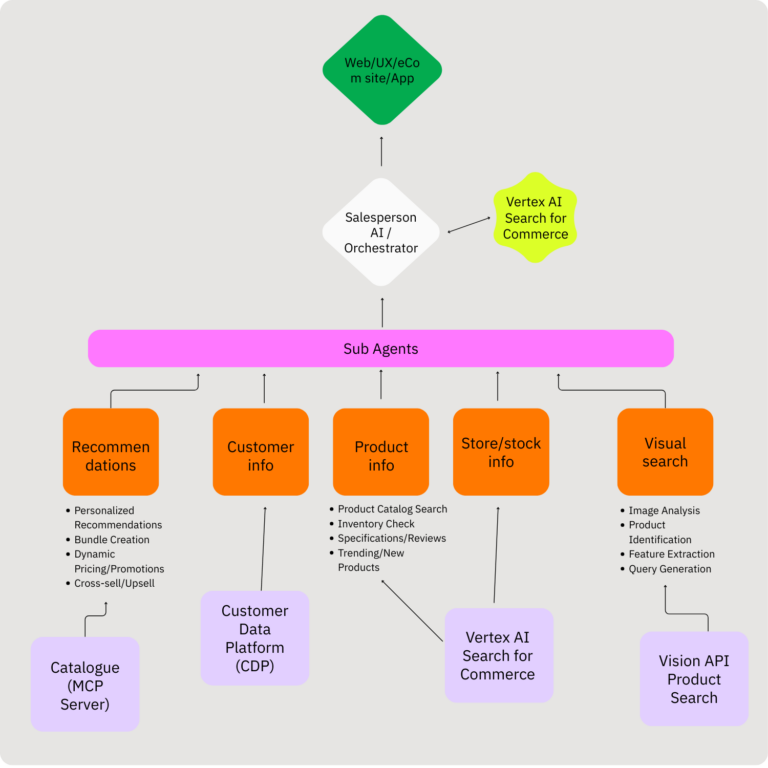
Integration: the backbone of a functional agent
A conversational agent becomes significantly more powerful when connected to the organisation’s systems and extended data. This includes:
- Product or service catalogues
- CRM and customer profiles
- Pricing and promotion engines
- Inventory, fulfilment or availability systems
- Booking systems or checkout flows
- Customer history and preferences
This integration allows the agent to personalise responses, validate availability, complete transactions and provide meaningful post-purchase support.
Responsible AI and guardrails
As organisations introduce conversational agents into customer-facing journeys, trust becomes a non-negotiable foundation. Customers will only embrace these experiences if they feel confident the agent is reliable, transparent and working in their best interest. Responsible AI practices ensure that the system behaves predictably, stays grounded in verified data and avoids generating misleading or speculative responses. With Vertex AI, this means implementing strong grounding strategies, defining clear behavioural rules, and ensuring the agent knows when to hand off to a human – especially for complex, high-stakes or emotionally sensitive queries.
Ongoing monitoring is equally critical: reviewing conversations, identifying failure modes, refining guardrails and making sure the system remains accurate and fair over time. These safeguards do more than mitigate risk, they reinforce the credibility and commercial value of the conversational experience by keeping interactions consistent, trustworthy and aligned with organisational standards.
How to measure success
Successful conversational experiences should be measured across multiple dimensions, including:
- Conversion rate improvement
- Reduction in customer effort
- Lower cost-to-serve
- Reduction in support escalations
- Completion rates for key tasks
- Drop-off rate across decision flows
- Customer satisfaction and clarity
- Improvements in data quality over time
Clear metrics help teams identify where the agent adds value and where to refine.
Personalisation and first-party data
The true potential of conversational commerce emerges when AI systems can draw on rich, high-quality first-party data to deliver deeply personalised guidance. When an agent understands a customer’s history, preferences, behaviours, loyalty status or location, it can provide recommendations that feel immediately relevant – much closer to the assistance a customer expects from a knowledgeable in-store consultant.
This level of personalisation is something generic, off-the-shelf AI systems cannot replicate, giving organisations a meaningful competitive advantage. Vertex AI’s ability to integrate with product catalogues, customer profiles and behavioural datasets enables the agent to adapt its reasoning, filter options more intelligently and progress customers through decision journeys faster. As privacy regulations evolve and third-party data becomes less reliable, first-party data becomes even more valuable. Organisations that establish these data foundations early will be best positioned to offer conversational experiences that feel genuinely helpful, not generic.
Omnichannel potential: beyond the website
One of the strongest commercial opportunities for conversational agents is their ability to provide consistent intelligence across multiple channels – not just on a website. A single well-designed agent can support customers in mobile apps, in-store kiosks, customer service centres, live chat environments or even on devices used by sales associates on the shop floor. Instead of fragmented experiences, customers encounter a unified layer of guidance that understands their context, preferences and history wherever they engage. This brings the strengths of Vertex AI and Search for Commerce deeper into the organisation, enhancing assisted selling, improving customer service and bridging gaps between digital and physical retail.
As omnichannel expectations continue to rise, organisations that deploy a shared conversational layer gain the ability to deliver continuity across touchpoints, reduce friction and boost the overall coherence of the customer journey.
How organisations can get started
A practical starting framework includes:
- Data audit and readiness assessment
- Prioritisation of high value journeys
- Establishing a strong search and retrieval layer
- Building a lightweight prototype
- Designing the behavioural and reasoning layer
- Testing with real customer language
- Iterating continuously
- Data audit and readiness assessment
Conclusion: conversational journeys are becoming the norm
Consumers are already turning to conversational interfaces to compare, choose and resolve issues. Organisations that build their own agentic experiences will reduce friction, improve clarity and deliver support that feels immediate and personalised.
Google Vertex AI offers one of the most complete and reliable foundations for achieving this. Other platforms provide flexibility but often at higher engineering cost. Regardless of platform, success comes from strong data foundations, thoughtful journey design and disciplined experimentation.
Restive is actively designing and building these systems across multiple consumer categories. If you are exploring how conversational AI could support your customers, we would be happy to share what we have learned. Contact us today to find out more.
Related articles