
Home ❯ Case Studies ❯ How we built an AI-powered product for a Sydney start-up – from concept to production-ready MVP in six months
How we built an AI-powered product for a Sydney start-up – from concept to production-ready MVP in six months
Client
Capabilities


Key outcomes
- Full product built and delivered in six months, covering architecture, design system, web and mobile front ends, and the AI layer
- AI document categorisation across identification, insurance, legal, medical and financial types, built on AWS Bedrock
- Conversational AI interface that guides users through complex life events in context
- Monorepo architecture with shared packages, so the React web app and React Native mobile app run on a single source of business logic
- Production-ready MVP delivered and handed over, launching with 2,000 committed customers migrating from a competing product
Introduction
Managing life’s most important documents is something most people put off until they absolutely can’t. When a loved one passes away, a car accident happens, or an insurance claim needs filing, the scramble to find the right information at the right time causes real stress. Licences, insurance policies, medical certificates and legal paperwork usually live in a filing cabinet, three inboxes and someone’s phone.
A Sydney-based start-up came to Restive with an idea and a vision to solve that problem, an AI-powered platform where households could securely store, organise and act on all their critical documents, and get intelligent support exactly when they need it most. They needed a technical partner who could take that concept and build it the right way: fast to market as an MVP, and designed to scale.
The challenge
Building a production-ready AI platform from a concept is a different challenge to iterating on an existing product. The start-up needed to move fast, getting to market with a working MVP quickly enough to capitalise on a ready-made base of 2,000 customers migrating from a competing product, while making the right architecture and security decisions from day one to support rapid growth from there.
The AI layer added further complexity. Document categorisation, conversational interfaces and context-aware guidance across complex life events all needed to work reliably in production, and not just in a demo environment. Sensitive personal, legal and financial records raise the stakes on every one of those decisions.
There was also a trust problem to solve. Families are handing over the documents that matter most to them, so an AI that silently files something in the wrong place is worse than no AI at all.
Our partnership
Restive brought together our Melbourne and Malaysia teams to deliver the full product build, covering architecture, design system, web and mobile front ends, and the AI layer, in a focused six-month engagement.
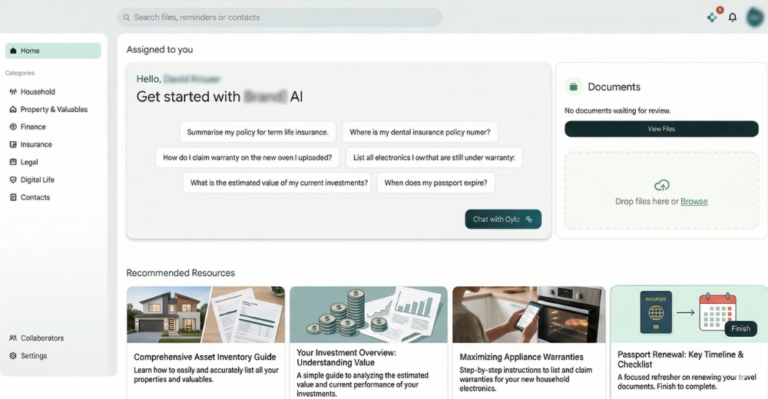
The AI capability is at the heart of the platform. Built on AWS Bedrock, it automatically extracts key information from uploaded documents and categorises them across identification, insurance, legal, medical and financial types, then surfaces them intelligently through a conversational interface. When a user needs to navigate a complex life event, the platform understands their context and guides them through it, from insurance claims to estate administration.
We designed the AI to propose and the user to confirm. Every categorisation is visible and editable, which keeps the family in control of where their records sit and builds the trust a product like this depends on.
We applied our rapid MVP delivery process from day one: establishing the right architecture and security foundations, building a scalable design system on Tailwind CSS and HeroUI, standing up a monorepo so the React web app and the React Native mobile app could share business logic, and shipping a production-grade product that could go to market quickly and grow from there.
Feature highlights
AI document intelligence
Built on AWS Bedrock, the platform automatically extracts key information from uploaded documents and categorises them across identification, insurance, legal, medical and financial types. Users upload once and the system organises everything, with no manual tagging required.
AI proposes, the user confirms
The AI does the heavy lifting and the household stays in control. Every suggested category and extracted field is surfaced to the user for confirmation, so families can see exactly how their records are being handled. That transparency is what makes people comfortable putting a death certificate or an insurance policy into a platform in the first place.
Dynamic template system
The AI reads each document and generates the template fields for it, so a passport and a home insurance policy are captured differently. Users can reorder, hide or remove fields, or build a template manually when a document does not fit the usual patterns.
Conversational AI interface
A context-aware conversational interface lets users ask questions and get guidance based on their specific situation. Whether navigating an insurance claim, estate administration or a financial event, the platform understands what the user needs and surfaces the right documents and next steps.
Monorepo architecture across web and mobile
We built the platform as a monorepo with shared packages, which splits the React web app and the React Native mobile app into individually manageable components while keeping a single source of business logic. Expo handles the mobile build and release pipeline, so the team ships to iOS and Android without managing native toolchains. New features land on both platforms without being written twice, and the codebase stays maintainable as the product grows.
Design system built on Tailwind and HeroUI
We built the design system on Tailwind CSS and HeroUI, extending it with a custom React component library. Composition over inheritance, centralised styling and modular components mean the team can ship new features quickly and keep the product visually consistent as it scales.
Household management and legacy planning
Households can add members, assign role-based access and nominate who inherits access to what. That last part matters most in exactly the moments the product is designed for, when someone needs to act on documents they did not create.
Security-first architecture
Handling sensitive personal, legal, medical and financial documents demands a security foundation that is right from day one rather than retrofitted later. We established the architecture and security controls at the start of the engagement, giving the platform what it needs to handle sensitive data at scale and meet the compliance requirements that matter to users and enterprise customers alike.
Technologies used
Layer
Technology
Frontend
Mobile
Architecture
Design system
AI/ML
Document processing
Cloud infrastructure
Authentication & security
The result
Restive delivered a production-ready, AI-powered life admin platform in six months, built on the right architecture and security foundations to scale rapidly from launch.
The client now has a centralised, intelligent repository that changes how households manage critical information, with automated categorisation removing most of the manual effort and a single source of truth that every household member can access. The monorepo foundation means web and mobile move together, so feature parity is not a recurring tax on the roadmap.
The platform is launching into market with 2,000 customers already committed to migrate from a competing product, a ready-made base to build from. The build is complete and handed over, and the client owns a codebase and an architecture their own team can keep building on.
Frequently asked questions
How long does it take to build an AI product MVP?
It depends on scope and complexity, but a well-defined MVP with a focused feature set can usually be delivered in three to six months. For this project, Restive took the client from early concept to a production-ready platform in six months, including a design system built on Tailwind and HeroUI, a conversational AI interface, a monorepo covering a React web app and a React Native mobile app, and a security-first architecture on AWS.
What is AWS Bedrock and why is it a good choice for AI products?
AWS Bedrock is Amazon’s managed generative AI platform. It provides access to leading foundation models, including Anthropic Claude, through a single API, without the overhead of training or hosting your own models. For start-ups it means access to enterprise-grade AI capability from day one, with AWS security and compliance built in.
How does AI document management work in a real product?
In this platform, documents uploaded by users are automatically classified, extracted and organised using AWS Bedrock. The AI identifies the document type, pulls out the key information, generates the right template fields for it and routes it into the correct category. The user confirms or adjusts the result, which keeps accuracy high and keeps people in control of their own records.
Why build a monorepo for a web and mobile product?
A monorepo with shared packages lets you keep one source of business logic while still shipping distinct web and mobile experiences. For an MVP on a six-month timeline, that means features get built once instead of twice, the two platforms stay in sync, and the codebase stays maintainable as the team and the product grow.
Can Restive work with early-stage start-ups?
Yes. Restive works with start-ups from the concept stage through to scale. The key is a clearly defined problem to solve and a commitment to iterative delivery. We embed experienced product, design and engineering consultants who have built production AI applications before, so you get momentum from day one rather than a standing start.
What does a production-ready MVP actually include?
A production-ready MVP goes well beyond a prototype. It means the product is secure, scalable, tested and deployable to real users. For this project that included a hardened security architecture, a full design system for consistency across web and mobile, and a conversational AI interface that performs reliably at scale.