
Home ❯ Case Studies ❯ Personalisation strategy and product discovery for Circle In
Personalisation strategy and product discovery for Circle In
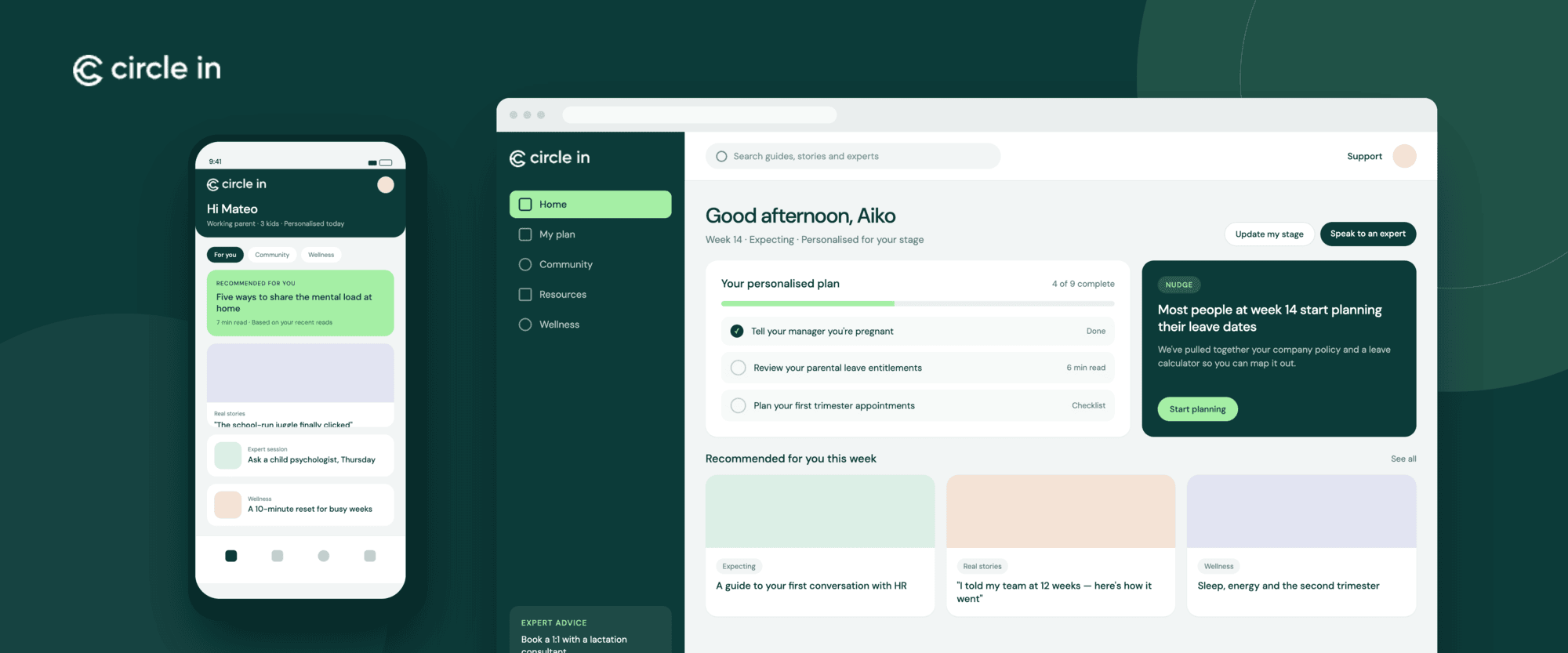
Key outcomes
- Three-horizon personalisation product strategy, presented to the CEO and board and endorsed unanimously
- New scalable platform replacing the legacy stack, cutting platform setup time by 68.75%
- Content publishing and updates 6 times faster
- Machine learning recommendation engine powering personalised content for every user
- UI library integrated with Storybook, standardising design-to-engineering handover
- 86% reduction in UX-related customer support complaints within 8 weeks
- Software craftsmanship program embedding clean code and test-driven development across the engineering team
86%
fewer UX-related complaints
6x
faster content publishing
68.75%
reduction in platform setup time
Introduction
Circle In is a platform built for working parents and caregivers, connecting enterprise clients with resources, tools and content that support people through the most demanding seasons of their lives. By 2021 the platform had seen significant growth and Circle In was ready to go further.
The next step was personalisation: making the platform more relevant to each individual user, at the right moment. Delivering on that ambition needed a platform capable of supporting it, and the legacy stack was never built for the job. Restive embedded within Circle In’s existing team to lead the whole thing, from product discovery and strategy through to delivery.
The problem
Circle In had built something that worked. Enterprise clients were on board, the user base was growing and the team was expanding, but the next phase of growth had several dimensions to it.
The first was strategic. What did personalisation actually look like for Circle In’s users? What content and tools were most relevant to which types of caregivers, and where were the gaps between what the platform offered and what people needed?
The second was structural. The legacy platform that had gotten Circle In this far wasn’t going to take them where they wanted to go, and scaling globally, simplifying content management and shipping new features fast were all difficult on the existing stack.
Underneath both of those sat a third challenge. As new features had been shipped, UX inconsistencies had been accumulating, generating customer complaints and making it harder for the sales team to demo the product with confidence. That couldn’t wait.
Circle In needed people who could hold all of these threads simultaneously.
Our partnership
Restive embedded a Head of Product & Design and a Senior Software Engineer, working directly alongside Circle In’s cross-functional team across product, technology, design and business stakeholders, so the work was grounded in the real shape of the organisation and built for their team to carry forward. This is how our embedded product and delivery teams operate on every engagement.
The engagement covered:
- Market research and competitor analysis to map the personalisation landscape
- User interviews and Voice of Customer research to understand the current experience
- Synthesising research into User Personas, Journey Maps and Affinity maps
- Discovery workshops and stakeholder alignment
- Defining the product vision and a three-horizon product strategy for personalisation
- Presenting strategy recommendations to the CEO and board
- Developing rapid prototypes to validate ideas with end users
- Conducting a platform-wide design audit to identify UX inconsistencies
- Building a UI library with standardised components for designers and engineers
- Integrating the UI library with Storybook to streamline design-to-engineering handover
- Leading the development of a new scalable platform to replace the legacy stack
- Provisioning infrastructure as code and building CI/CD pipelines for rapid, reliable releases
- Delivering a data consolidation component to integrate systems across teams
- Supporting and enhancing the existing data lake solution
- Configuring SAML SSO and OAuth2.0/OIDC authentication for enterprise clients
- Collaborating with tech and design teams to develop a prioritised product roadmap
- Delivering a machine learning recommendation engine to power personalised content
- Running a software craftsmanship training stream covering clean code, TDD, test patterns, refactoring and domain-driven design
- Market research and competitor analysis to map the personalisation landscape
Running the discovery
The starting point was going directly to users. We ran customer research interviews across Circle In’s base to capture their experience of the platform, identify where it was falling short and build a clear picture of what personalisation could mean for different types of caregivers.
That research was synthesised into User Personas, Journey Maps and Affinity maps, concrete artifacts that grounded every internal discussion in the reality of end user needs. Competitor analysis ran alongside this to map the personalisation landscape: what others were doing, where the gaps were and where Circle In had the most to gain.
What came out of it was a set of actionable insights and a clear-eyed view of what the legacy platform could and couldn’t support, which became the foundation for everything that followed.
From vision to roadmap
With discovery complete, the work moved from understanding to direction. A three-horizon product strategy was developed and presented directly to the Circle In CEO and board, and received unanimous endorsement. That alignment gave the team a shared, evidence-based foundation to build from.
From there, Restive worked with Circle In’s technology and design teams to translate that vision into a concrete roadmap, sequenced, prioritised and grounded in what was buildable.
The roadmap centred on a significant platform investment: replacing the legacy stack with a scalable architecture designed to simplify content management and give the development team the speed to release new features without friction. The goal was to build a platform Circle In could grow into as they expanded globally, and to make sure the team left stronger for it. Alongside the platform build, Restive ran a software craftsmanship program to uplift engineering practice, embedding clean code and test-driven development as standard.
Running alongside the platform work was a full UX overhaul. It started with a structured design audit, drawing on volunteers from across every business function to surface and document inconsistencies across the platform. Those findings were turned into a prioritised problem statement backlog. Wireframes were developed for the highest-priority issues, and the solution that emerged was clear: a UI library of standardised components, integrated with Storybook to create a consistent, repeatable process between design and engineering. Rapid prototypes were built, tested with real users and iterated before anything went to production.
At the centre of the personalisation roadmap was the machine learning recommendation engine, the capability that made personalisation work in practice, serving each user the content most relevant to their situation.
“Prior to this uplift, I would be nervous giving demo access to prospects because I have no control over how they interact with the platform. Now that most issues are a thing of the past, I can be fully confident handing over the keys.”
The outcome
The new platform delivered immediate, measurable results. Platform setup time dropped by 68.75%, over 3 times faster than before. Content publishing and updates became 6 times faster, an 83.33% reduction in time. The scalable architecture did exactly what it was built to do and gave Circle In’s team the speed to ship without friction.
The UX overhaul landed just as clearly. Within 8 weeks of rolling out the UI library improvements, customer support saw an 86% reduction in UX-related complaints, and the impact reached the sales team too.
Circle In came to Restive with a personalisation ambition, a platform that wasn’t ready to deliver it and a user experience that was starting to erode confidence. They left with a board-endorsed three-horizon strategy, an architecture publishing content 6 times faster, a machine learning recommendation engine, a UI library that cut customer complaints by 86% in two months, and a development team better equipped to carry it all forward.
If you are weighing up a similar move, here is how we work.
Frequently asked questions
What is product discovery and why does it matter before a platform build?
Product discovery is the research and validation work that happens before committing to a build. It covers user interviews, competitor analysis, journey mapping and prototyping, and it exists to establish what to build and why. For Circle In, discovery surfaced what personalisation meant to different types of caregivers and gave a clear view of what the legacy platform could and couldn’t support, which shaped the entire roadmap that followed.
How do you build a personalisation strategy?
A personalisation strategy starts with understanding who your users are and what each of them needs at different moments. That means research first: user interviews, Voice of Customer work, personas and journey maps. From there you define the product vision, sequence it into horizons so the team knows what comes now and what comes later, and identify the platform capability required to deliver it. For Circle In that capability was a machine learning recommendation engine sitting on a new scalable architecture.
What is a three-horizon product strategy?
A three-horizon product strategy splits the roadmap into near-term, medium-term and longer-term ambitions. Horizon one covers what the team can ship with current capability, horizon two covers what needs new investment, and horizon three covers the bigger bets that depend on foundations being laid first. It gives executives and boards a way to fund a direction without pretending the whole thing can be delivered at once.
How does a UI library reduce customer complaints?
UX inconsistencies accumulate as teams ship features quickly, and each inconsistency is a small point of confusion for users. A UI library of standardised components removes that variability at the source, because designers and engineers build from the same set of tested patterns. Circle In saw an 86% reduction in UX-related support complaints within 8 weeks of rollout.
Can Restive work inside an existing product and engineering team?
Yes, and that is our default model. For Circle In we embedded a Head of Product & Design and a Senior Software Engineer directly into the existing cross-functional team, working alongside their product, technology, design and business stakeholders. The point of embedding is that capability stays with the client team when the engagement ends.
How long does a discovery and personalisation engagement take?
Discovery itself typically runs six to twelve weeks depending on the number of user segments and stakeholders involved. The delivery work that follows depends on scope. For Circle In the engagement ran through discovery, strategy, a full platform replacement, a UX overhaul and a machine learning recommendation engine, with measurable results landing within 8 weeks of the UI library rollout.